To say that Democrats are killing us, would not start too many arguments. People are feeling the effects first hand and know well what I mean when I say it. But… If I say they are doing it on…
Source: The Ghettos Are Always Blue
To say that Democrats are killing us, would not start too many arguments. People are feeling the effects first hand and know well what I mean when I say it. But… If I say they are doing it on…
Source: The Ghettos Are Always Blue
A preschool child is the perfect human learning machine, gathering survival information through every one of the five senses, and perhaps his sixth. A child is born with unique and inherited DNA in which are embedded characteristics and traits which have helped related generations survive prior to the time of his birth. In other words, he is born knowing much about how to navigate the world he has never known or experienced. He has also been accumulating information in utero, responding to and remembering sounds and watery experiences long before he is able to verbalize them. Children from the very first day of life are filled with an unearthly wisdom, which adults gradually and constantly erase, as the baby moves along his natural path of development.
I believe this because I recall how it felt to reside in that early stage of life. I was in my high chair in the kitchen and I knew the woman at the sink was not my mother. I felt she was my second choice even though she had just placed food in front of me moments ago. She was distracted and disengaged in a way my own mother never was.
I see the blocky back side of her as she leans into her work at the kitchen sink. I am resentful it is not the slender figure of my mother. Her apron is tied over the house dress, and she has on stockings and house shoes. I do not like this combination, but I remember the feel of ladies’ legs covered in nylons, so smooth and silky to my sensitive hands. I begin to rub my hands across the tray in front of me, and it is wet with some kind of food, and it feels wonderful beneath my palms. I forget about the woman at the sink and immerse myself in the experience of the food on the tray in front of me. The room is sunny and bright from the window over the sink in front of my grandmother. I am in a reverie of tactile learning, lost in the taste, smell, and feel of the tray and the food. I feel for my hair, which connects to a related memory of “silky” and am surprised it does not feel smooth at all. Grandma Sophie turns to me, and is laughing and speaking in Norwegian and chiding me in a very loving way, wiping at the tray, removing the learning like magic, and I am polished by a smiling face. I feel her hands, but in my mind, I believe her face is doing it, and I am loving her openly and without reservation. She allows me to remain in the chair with the tray, and turns back to the sink. There is some kind of distraction placed in front of me, but it holds no attention as it is cold, noisy and metallic, and has hard edges.
It must have been measuring spoons. But the spell was broken. I was cut off from smoothness. I accepted this, but felt disappointment…I did not cry. Moments later, my sisters came in from outside, and I felt fully joyful.
Diane sweeps past me, on the right. I feel the burst of her energy, and watch her disappear. Grandma Sophie says something to her in a sharp tone. It is in English, heavily accented. Diane responds with a happy tone, but does not return to the room. My sister Pam, four years younger than Diane, comes straight over to talk to me, and play with me. Her face is small, and her hair moves around it like a halo as she speaks to me. Her chin barely reaches over the height of the tray. Her excited smiles and chirps of affection stir up the same feelings of unguarded love I felt a moment ago. Grandma Sophie pulls out a chair, causing a very loud noise that startles me, breaking the reverie. She sits down heavily and somehow causes my sister Pam to leave me and go to the table to sit with her.
I was alone then. There was nothing to learn at the moment. I sat quietly and waited for something to happen. My eyes studied the linoleum, my nose sniffed the fresh air of the outdoors brought in by those little girls, and my ears were listening for those who were absent. I was aware they would be coming, and soon. I already knew the pattern of my days.

I have asked my sister about this memory, and she validated I must have been barely two years old. She knew the kitchen, the name of the street, and why my mother was not home. She filled out some more of the details and we both marveled this particular hour had travelled with me for over sixty years, intact, and fully accurate in every detail.
We had two grandmothers, both full Norwegians. My paternal grandmother did not live with us, but on a farm in far northern Minnesota, in the town of Oslo. She was a widow. Our grandfather Elling had died before most of us came along. Grandma Thilda had survived this loss, and the loss of some of her children, which gave her higher status by comparison to my maternal grandmother, Sophie. She was not blamed for her losses, and was surrounded by sons and daughters who made up for them with endless hard work and singing in the darkest, coldest nights.
Sophie lived with us off and on. She was our other grandmother, the one who had also suffered the loss of her husband, but had additionally been forced to endure the shame of abandonment by him, our grandfather, William, just when her house was full of his six children and he simply could no longer abide her company. She had a grown son who stepped into the role of man of the farm. He was my mother’s younger brother, Eber. Grandma Sophie never wavered from her role as loving mother, yet in her grief and anger could never explain to anyone where her husband went or why. For this reason we seldom mentioned it.
Uncle Eber had been tall, good looking, and by all reports, heroic. Athletic and full of fun, Uncle Eber and my mom, Adeline stepped up to fill their father’s position as well as two teenagers could. They did this together for the sake of their mother and their four younger siblings until Uncle Eber was suddenly removed as place holder for his father when he went off to war and was killed in action overseas. Eber resided in the wings off stage in our daily family life, invisible but fully present in his absence.
It is no small thing to live with dead people, especially heroic ones. Grandma Sophie would hold an old snap shot out for us to examine. We would see a slender Norwegian boy in American Uniform, dapper in his cocked hat, beaming proudly at us with his dazzling smile. His mother would tell us what kind of son he had been, how great he was, and how loving and humble and hard working. Her voice would tremble, and she would lift a corner of her apron to dab at her eyes. We would look helplessly from her face to the black and white image, missing the connection entirely. We suffered his loss piteously, wished him back for her, sorrowed as well as we could, but knew we would never measure up. Never. Eber was mythical. Even our own mother said as much when it was her turn to tell us how her brother turned poverty and suffering and loss into golden days of joy and laughter when he partnered with her in raising an abandoned family.
We were made aware our careless joy was unearned and perhaps undeserved. Far be it from Sophie to say what God should have done, but she would have had it another way. The hem of her dress was caught on a rusty nail on a Depression era hen house, and she was incapable of lifting it off by herself. Though we had been sent to help her, our giggles echoed but faintly from a distant future. The poor farm woman could no more explain our existence than where her husband and son had gone, or why.

…to be continued
I grew up in a beautiful America. Dad was Dad, and Mom was Mom and every home had those two individuals. Kids were either boys or girls, and very generic after that. When our mom and dad made friends with other moms and dads, we always demanded to know about their children, eager for playmates of our own age and gender. When two families got together, it was an instant party, a house full of laughing people, with food the mother of the house had grown in her garden, baked in her oven, or “fixed for us” in her brand new kitchen.
It was an era when each American felt freshly vindicated by having conquered the Nazis who tried to murder millions of innocent civilians simply for being Jewish, or having Jewish “sympathies.” We were born several years after the end of World War II, and knew no suffering, no lack, no fear. Our parents were children of the Depression who had known hunger, lack, and bone-chilling cold in winters that seemed endless. By contrast, our homes were heated in winter, and Union Gas showed up monthly to refill the fuel supply in our basement. As a child I would watch out the window and call out to my mom, “The Onion Man is here!” When she asked why I called him the onion man, I said, “That’s what it says on the truck.” (I was a Phonics kid. For me, the word “Union” did not start with a “Y” but with a “U” so UNION man it was.
Our parents would never discuss the war, but the Depression was frequently mentioned. The tone was unanimously informative and cautionary from parents, grandparents, aunts and uncles. It was as if they had barely survived total immolation, but for God’s hand, and if we were not careful, we would suffer the same. This awareness of God’s grace, and their relief at His providential solutions to poverty, genocide, and starvation was real, and no small thing, nothing to take for granted. We were occasionally warned that our days of careless play and full bellies could well be numbered. We laughed behind their backs, certain the stories were only fables meant to teach us manners and godly behavior.
Freshly laundered clothing flapped in the sunshine outside, and long white diapers and sheets caught breezes as my grandmother bent to the heavy basket and pinned up even more. She would raise a cranky voice and tell us something in Norwegian as we chased each other through the wet billows in an effort to run without being caught in them. We knew what she was saying, even though we spoke nothing but English. In those days, children listened for tone, more than the words themselves. Adults spoke “grown up” and we spoke “child” and it seemed two separate things. We listened for “angry” or “inviting” or “pay attention” or “stop it.” Other than these simple tones, we ran freely past them, paying no attention.

We were so confident of their love and provision we took them completely for granted, and when they told us of their impoverished childhoods, they spoke in hushed and embarrassed tones. They spoke of their memories in shame, and it humiliated us that our own parents had known that kind of lack. We would edge away from their sad narrative, scared and suspicious it might be congenital in nature. It was not in keeping with the sunshine of our own experience, and we knew they were speaking truth, but we had no place in our hearts and minds to file these stories. It was important to them. It marked them. It was our heritage and they wanted us to have it, but we were not willing to receive it.
to be continued…
Critically important idea, and Rebecca Mahoney writes about it in a way thatt is crystal clear.
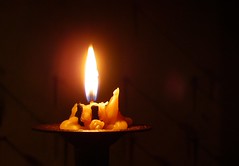
Votive (Photo credit: selva)
At times, the awareness of what it all means escapes us, and at other times, we totally comprehend the meaning yet cannot find the courage to share it. Writers have a responsibility to bring some kind of meaning to events both large and small, happy and sad, and we toil to bring sense out of the senseless.
This is where the authentic, sad, and monstrous stuff of life threatens to immobilize the very people who carry the light. We stand with the votive candle in our trembling hands, fearful the rain and wind will extinguish the only light we have. In past times it has. This was before. It was before we realized we had these candles for a reason. We do not need to figure out why we have them. We need to figure out what to DO with them while there is still time. Tonight I will light and relight and keep lighting my small source of light until others find the courage to do the same.
At the Vermont Studio Center last summer, I made a tiny and casual observation at the conference table of twenty or so writers who had come to study the craft of candle bearing. During the introductions, each was doing his or her best to present himself as someone who had studied, accomplished, published, and was continuing to do even more. As I listened to each one, I was in awe of the talent, the degrees, and the literary work they were doing on a daily basis. For example, one handsome youth who appeared to be about 17, was actually a college professor who was working to translate Chinese poetry into English.
I had nothing to compare. I sat quietly, hoping to be skipped, but one of them said, “What about you? Are you hiding back there?” It was said in jest and with great kindness, but I actually was hiding because I had nothing to say to make myself relevant in such company. Instead I proffered this, “I am Tandy Belt, and I write reality. I am an online blogger. I also write creative non-fiction.” They seemed interested and also surprised. I felt bold enough to continue, “I have been listening to all of you and I must say the credentials are very impressive! I am in awe of each one of you, but I want to say one thing: In the dark of night, when you are alone and afraid you are not quite good enough, smart enough, or talented enough to continue, remember that you are. In your own individual way, in all kinds of areas of effort, you are keeping the light alive. If someone comes by you and blows out your candle, light it again, and again and AGAIN. This is what I do, and will always do, and I will never let my candle go out permanently.” I said it emphatically, because I meant it.
I am telling no lie. Every single face around that table registered some combination of relief, agreement, empowerment and appreciation for what I had said, and I was surprised. But simple truth has relevance, and is always immediately recognized. It removes fear and brings goodness out of hiding. It is empowering, even when stated with apprehension.
The next day, many came up to me, seeking me out for a private word. I was absolutely stunned. One sweet and shy girl said, “We had a gathering last night and talked for hours about what you said yesterday. We all appreciated it so much!” Then she embraced me, and kissed me on the cheek!
Seriously? I learned something important right then and there. It is not the published work, the PhD, or the high paying position at a prestigious school that brings security, because we are all afraid. We all need encouragement. We are all lonely, wounded, doubtful of our own worthiness to continue. It is this pervasive fear that drives us to write, to light those candles, to hope.
Tonight I am struggling to light a candle whose wick is wet. My matches are damp. My hands shake. Even here in the darkness, I cannot stop struggling to find a way to get it done. AGAIN.
The numbing cold left behind by the massacre of kindergarteners in Newtown, Connecticut threatens to keep me in darkness once and for all. Rain pelts my face, and has the sting of icy fingers around my throat. I have nothing to say, I plead. Let me hide my failure. Let me give up my hope. But my own words come back to haunt me so I keep struggling against the odds. How can I think of even one thing to say?! My candle is extinguished. Yet I remember I am a light carrier, and people are waiting. A feminine voice taunts from a faraway corner. “And what about YOU? Are you HIDING back there?” THE VOICE IS MY OWN.
I strike the match one last time, and there is a small flame. I hold it to the wick until my fingers get hot. It fires and sputters, but the light has come. The flame transfers to the candle and I drop the match with great relief. I hold my candle carefully as the comforting light expands so I can see those who are suffering all around me. I am not alone. I was never alone.
I hold it up and the faces, though twisted with grief, turn to the sudden light. There is an instant awareness not one of us was ever truly alone, despite our perceptions moments before. The light reveals gaps in the crowd. We have missing. The small spaces between some parents…the tall spots among families with children. We have 28 gaps all told. We all see the gaps and say nothing.
What is most painful about being a light carrier is having to recognize both good and evil. We must accept and acknowledge that both are true and exist simultaneously. The simple truth I must share now is this: It is in our own individual power to change the balance of it. In addition, we are powerless to make that change for anyone else.
Someone blew my candle out, but I have managed to light it once more. I will do this again. This is my decision, even if I were the only one left who was able to do so. I encourage you to do the same.
Today I feel led to write about Jesus and his treatment, opinion and honor of women. Seems to me he went out of his way to level them with men who traditionally put us in a lower category. 2,000 years ago, Jesus was pretty advanced. I am thinking of the story of “The Widow’s Mite”. Apparently, people were lined up, dropping various sums of money into the offering plate, and those who were watching commented on how large some of the donations were.
Jesus had noticed a widow in line, who dropped in a tiny amount, but he recognized it was all she had to live on. In other words, she gave it ALL. He said, “She has put in more than anyone else.” This truthful observation shocked some who did not even notice the mite, as it fell among the gold and silver beneath it.

I can picture her moving forward, being jostled about in her faded clothing, aware of her lowly status in such a crowd. Her feet were probably hurting, and maybe she had poor vision. But she was on a mission. She had a penny in her hand, and she wanted to make an offering. Without fanfare, she let it drop into the receptacle and Jesus noticed. This tiny event from such a long time ago is recorded in the Bible because Jesus said, “All the others put in out of their wealth, but she out of her poverty, put in all she had to live on.”
All she had to live on. Seriously? If all I had was five dollars, and had not had lunch yet, I doubt I’d drop it into the offering plate at church! Yet this is what she did, and without expectation of any kind of return.
Jesus recognized her for doing so, and despite the many lofty thoughts running through his mind on this ordinary day, commented on it. It was included in the Bible for all posterity. A singular honor for a mite.
The widow gave 100%. Jesus noticed. He found it remarkable.

Blood Sweat and Tears. Number 2 (Photo credit: Jakob E)
When Cain killed his baby brother Abel, he thought he got away with it, but the Bible says God confronted him, saying, “His blood cried out to me from the ground.” It isn’t that God did not see the murder as it happened, but the death was just the beginning of the story. Cain, in typical sociopathic fashion had already put it out of his mind. He felt no remorse.
God asked him where his brother was, and Cain replied, “I don’t know.” Then in an even more off-hand remark, “Am I my brother’s keeper?” or in today’s syntax, “How should I know? I don’t care where he is or what he is doing.” But the blood soaked soil was ringing into God’s ears at that very moment.
To GOD he said this! Lying to God’s face is a not a good idea, and Cain paid the price. He was not struck down, but God put a mark on him, and cursed the ground that had been his line of work. Cain, from that point on, wandered the world as a marked man.
I have to wonder if this is true of all murders. Because blood is an important life force, I believe it is. If so, America is a blood soaked land. In thinking it over, we must stop lying to ourselves, especially but to God in particular. We should CARE. And we do, momentarily, but ten minutes after hearing of another victim we forget about her. We move on, as if we are not her keeper…
Think of the number of outright murders (in the world at large) we have processed during our lives! Even if you limit it to premeditated murder, it is a huge number! Limit it to just America and it is still astonishing. Daily we hear of another and another and another…and we have come to accept it. But this unending violence in our streets and homes is sickening beyond comprehension. All this blood!
This blood cannot be disregarded by a civilized society. We must never even think of saying to ourselves, much less to God, “How should I know? Am I responsible for others?”
America’s society of tolerance and restraint has arrived at the point we cannot go on and remain a civilized society. The violence against innocent women and children at least should force us to cry out to each other and to the Holy God Himself. We are each other’s keeper, and to continue believing we are only responsible for our own selves and our own well-being is just too thin a cover.
“Mom, I think Jesus was anti-woman.” I was 22, and everyone knew Mom was a Bible Scholar, deeply immersed in the Bethel Series http://www.bethelseries.com/home.aspx which was an honor in itself. A handful of students had been carefully selected by the pastor of our church. It was a two-year commitment, and at the end, these ten hand-selected people would be certified to teach the series to anyone who wanted to attend.
“Why do you say that?” she asked, surprised by my statement, but not threatened.
“Well, he had twelve disciples, and every single one was a MAN.” I gazed into the face of my mom, expecting her to say I never thought of that! but what she actually said was, “True, but why do you think that was?”
“Because he was anti-woman, and if he despised them then, he probably doesn’t care about them now.”
She nodded, thinking of what she should say to this bit of blasphemy. I did not flinch. I waited.
Finally she said, “Tell you what, why don’t you do a Bible study on the life of Jesus as regarding women, and only women, and see what you find.”
I felt a little naked, because I was no Bible scholar. I was flippant, self-satisfied, and careless regarding things of the faith. I had been coasting on her coat tails, using her wisdom and knowledge as a convenience during the tough questions of life.
But I heartily accepted her challenge, narcissistically thinking if I could prove Jesus was anti female, I could debunk the rationale for following him. (It was the early seventies, and most young women had burned their bras by then. I was probably not wearing my own during this conversation.)
She kind of chuckled and said, “Remember one thing: It was the men who fell away when he needed them most. It was the women who stayed by his side.”
I left the house, and went back to my apartment, anxious to delve into my Bible study, determined to uncover examples of females being second class citizens. Did it not say in the Bible story of his birth, “Glory to God in the highest, and on earth good will to men on whom his favor rests.”? In the shallow waters of my biblical knowledge, I had openly challenged the Bible in its entirety with a Sunday school understanding of the Christmas story, the Easter story and the saga of the Jews roaming around the desert for forty years, until the ten commandments had been written on stone a couple of times. Such was the naiivete of my approach!
Mom laughed as I went, unfazed by her wayward daughter, which made me even more resolute. I am not proud of this history, but I will be forever grateful my mother did not “teach” me in that moment. She invited me to teach my SELF, and I had no idea what I was about to discover.
The first story to occur to me was the story of his birth. It made sense to me to begin at his beginning, and follow his life chronologically as he went along, underlining in RED, the many places where he would favor men over women. What can I SAY? It made sense to me at the time.
I found out Jesus (in utero) was a human child fathered by the Holy Spirit of God. I had always accepted this, but it had never occured to me the human, flesh, natural part of him was no man, but issued from a woman, female, and God could have done it any other way, but selected a woman, and not one of any stature, but a young and “ordinary” woman. The biological DNA of Jesus was female in origin. God paired with a female to bring about the Son of Man!
At the time, I found this truth astounding. I closed the Bible, looked out the window and sat there alone, contemplating the meaning of this news, realizing it changed everything I had previously believed. It wasn’t I had never heard it. I was schooled in it from birth, but I had never realized it. From that moment I wondered what ELSE I had heard, but failed to understand.
There is a lineage of four women listed as progenitors of Jesus. They were Tamar, Rahab, Ruth and Bathsheba, not one of them “pure” even by modern standards! Rahab, for example is labeled as a prostitute. She is the woman who played an absolutely pivotal role in the story of the Israelites who were preparing to overtake the city where she was “working”. Laughing…some versions call her an “innkeeper”!
Anyway, somehow two spies were sent into the city to see what they would be up against if they attacked the great city of Jericho. She took them in, and told them the entire city and all its men were terrified, and emotionally unprepared to resist these special people of God, which was critical information. When soldiers from the city came looking for the spies, Rahab hid them under stalks of flax on her roof. She told the soldiers the spies had left, but she did not know which direction they had taken. The soldiers left the city to hunt them down. When it was safe, the Israeli spies came down and thanked her. But she wanted something in return: She brokered a deal with them to allow her and her family safety when her city of Jericho was attacked. They would not be killed.

Rahab and the Emissaries of Joshua (Photo credit: Wikipedia)
They agreed she would hang a scarlet cord out her window, and she and her family would be spared during the battle of Jericho. The grateful spies returned to camp and told the Israeli army about the scarlet cord signal ahead of time. As the story goes, she and her family were the only survivors who walked away. The battle left neither man nor woman, nor child, nor animal after the walls fell down. Only Rahab and her mother and brothers walked away.
She joined the victors and lived as part of them thereafter. An ordinary woman played an extraordinary role in one of the most famous battles ever recorded! Her life was spared as a reward. It all seemed so random at the time. She probably blended in after that.
“God uses the foolish things of this world to confound those things that are wise.” Rahab was one of the foolish, a street person, and one of female gender. Even now, a woman of the streets is almost invisible as far as influence in society. Back then it was more so.
She had no idea it had been anything more than a “deal” even while living out the remainder of her days. She was a woman of desperation who chose to trust the enemy instead of taking her chances on the streets of Jericho. She knew the meanness of those streets and the people who walked on them. She took a chance, and lived to tell the story of how she saved her family with a scarlet cord hung out the window.
She had no idea she would eventually be mentioned in the lineage of Jesus, no awareness he would share her DNA when he was born. But this is exactly what happened.
No life is random.


